

Quality Engineering Directors Don't Manage Tests. They Design Delivery Capability.

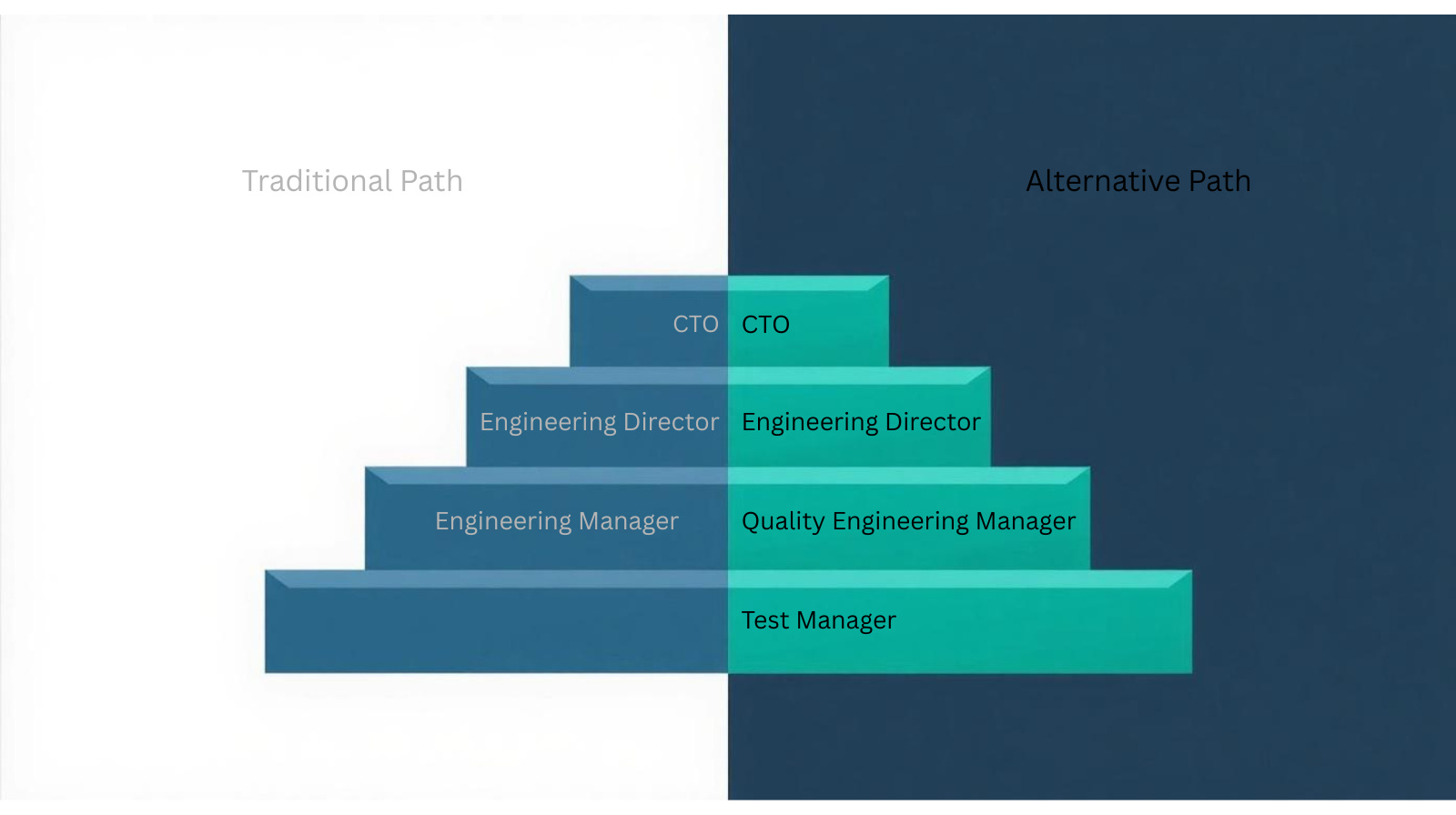
Two paths to CTO.
Traditional: Development Manager → Engineering Director → CTO
Alternative: Test Manager → Quality Engineering Manager → Engineering Director → CTO
The second path might be better.
Here’s why quality leadership skills are more suited for the C-suite than traditional engineering management.
The Role Evolution Nobody’s Talking About
Traditional QA Director: Manages testing team. Reports defect metrics. Gates releases.
Quality Engineering Director: Designs CI/CD pipelines. Embeds quality into architecture. Enables continuous delivery.
Same budget. Different scope. Different career trajectory.
One leads to CTO. The other doesn’t.
The shift happened when AI and DevSecOps changed what quality leadership means. Quality moved from defect detection after development to defect prevention during development. From inspection at the end to embedded partnership from the start.
Traditional QA directors manage test execution. Quality engineering directors design delivery systems.
That difference determines who reaches the C-suite.
Understanding the Paths
The evolution path varies by region and organisation size.
Australia and Europe: Test Manager → Quality Engineering Manager → Engineering Director → CTO/CIO
US tech companies (larger organisations): Test Manager → Quality Engineering Manager → Engineering Director → VP Engineering → CTO
US and global (smaller organisations): Test Manager → Quality Engineering Manager → Engineering Director → CTO/CIO
The titles change. The skill progression doesn’t.
Engineering Director is the bridge role between quality leadership and the C-suite. In Australia and Europe, Engineering Director to CTO is the final step. In large US tech companies, VP Engineering adds another layer.
What matters isn’t the title. It’s the transition from quality specialist to engineering leader to technology strategist.
Here’s why quality engineering directors are positioned for that progression.
What CTOs Actually Do
CTOs don’t manage engineering teams. They don’t write code. They don’t run sprints.
CTOs do five things:
Set technology vision aligned with business strategy. Manage enterprise-wide technical risk. Drive digital transformation and innovation. Translate technology investments to business outcomes. Build organisational technology capability.
These are strategic responsibilities, not operational ones.
Engineering directors and VPs of Engineering handle operational delivery. CTOs handle strategic direction.
Industry research shows CTOs need strong leadership and the ability to foster organisational culture. Not just technical expertise.
The question isn’t whether quality managers have engineering skills. It’s whether they have strategic leadership skills.
Most do. They just haven’t positioned themselves that way.
Seven Skills Quality Engineering Directors Already Have
1. Risk Management at Enterprise Scale
Quality engineering directors assess risk across the entire delivery pipeline. What could break in production. Where defects hide. Which changes are dangerous. What’s the blast radius.
CTOs manage enterprise-wide technical risk. Security and compliance risk. Technology investment risk. Business continuity and disaster recovery.
Quality engineering directors think in risk probability and impact every day. CTOs need this at enterprise scale.
Traditional engineering managers optimise for delivery speed. Quality leaders optimise for risk mitigation.
Which skill matters more at CTO level?
2. Business Outcome Translation
Quality engineering directors translate technical decisions to business outcomes.
Not this: “We have 500 flaky tests consuming 40% of QA capacity.”
But this: “$150K annually servicing test automation debt. Investing $200K in test architecture will cut this to $50K annually. ROI: 187% in year one.”
Same problem. Different language. Different executive response.
CTOs translate technology strategy to business outcomes. Technology investment to competitive advantage. Platform architecture to business velocity. Technical debt to opportunity cost.
Research confirms this is a core CTO capability. The ability to translate complex technical concepts into business language for CEOs, investors, and board members.
Quality engineering directors already speak this language. Traditional engineering managers speak feature delivery language.
Which language does the board speak?
3. Systems Thinking Across Organisation
Quality engineering directors see the entire delivery pipeline. Dependencies across systems. How components interact and fail. Bottlenecks that slow releases. Architecture that enables or prevents quality.
CTOs see the entire technology ecosystem. Enterprise architecture strategy. Platform thinking across business systems. Technology portfolio management. Scalability and reliability at organisational level.
Quality engineering directors already think in systems. CTOs need this perspective at enterprise scale.
Traditional engineering managers see their product or team. Quality leaders see how everything connects.
Which perspective matters more at CTO level?
4. Cross-Functional Influence Without Authority
Quality engineering directors influence without direct authority.
They influence developers to write testable code. Product teams to scope releases reasonably. Operations to support testing environments. Leadership to fund quality initiatives.
CTOs influence without direct authority over most decisions.
They influence CEO and CFO on technology strategy. Sales and marketing on digital capabilities. Board members on technology investments. Business units on transformation initiatives.
Quality engineering directors operate through influence and data, not command. Traditional engineering managers have direct authority over their teams.
Which experience matters more at CTO level?
5. Strategic Technology Decisions
Quality engineering directors make build versus buy decisions daily.
Evaluate test tools versus build custom frameworks. ROI analysis on automation investments. Vendor management for testing platforms. Total cost of ownership calculations.
CTOs make these decisions for the entire technology stack. Strategic build versus buy for platforms. Technology vendor relationships and negotiations. Long-term technology investment planning.
Quality engineering directors already make these decisions for testing. CTOs make them for the entire organisation.
Same decision framework. Different scope.
6. Executive Visibility and Metrics
Quality engineering directors track leading indicators. Test stability. Automation coverage. Quality debt accumulation. Release readiness.
They translate these to executive dashboards. Defect rates to customer impact. Quality debt to financial cost. Testing bottlenecks to delivery delays.
CTOs need the same capability. Technology health metrics for board reporting. Innovation and capability metrics. Technology investment ROI tracking. Competitive positioning indicators.
Quality engineering directors already build executive-level dashboards. Traditional engineering managers report team velocity and feature completion.
Which metrics matter at board level?
7. Organisational Change Management
Quality engineering directors drive organisational change.
Shift testing left. Embed quality in development. Transform QA from gatekeepers to enablers. Change organisational culture around quality.
CTOs drive change at enterprise scale. Digital transformation leadership. Cloud migration and modernisation. DevOps and DevSecOps adoption. Cultural change around technology.
Research emphasises that CTOs must inspire teams and drive cultural transformation. Leadership and team-building skills matter more than purely technical expertise.
Quality engineering directors already drive organisational change without direct authority. Traditional engineering managers manage change within their teams.
Which experience prepares you for enterprise transformation?
Why Traditional Engineering Path May Not Prepare You
Development Manager → Engineering Director → CTO seems like the obvious path.
But traditional engineering progression develops different skills.
Traditional engineering managers focus on:
Team management. Hiring, performance reviews, career development.
Project delivery. On time, on budget, meeting requirements.
Technical excellence. Code quality, architecture decisions, technical debt.
Roadmap planning. Features, releases, sprint planning.
These are operational skills. Valuable for Engineering Director and VP Engineering roles. Less relevant for CTO.
Traditional engineering managers have direct authority over their teams. They manage execution. They deliver features.
CTOs need strategic skills. Influence without authority. Enterprise-wide thinking. Business outcome translation. Organisational transformation.
Industry analysis shows the CTO role prioritises leadership, communication across departments, and the ability to foster collaboration over purely technical depth.
Quality engineering directors already operate this way. Traditional engineering managers don’t until they reach director level.
That’s why quality leaders who position themselves strategically can leapfrog traditional engineering progression.
The AI and DevSecOps Accelerator
AI and DevSecOps changed what quality engineering directors do.
Traditional QA directors manage manual testing efforts. Coordinate test execution. Report defect counts.
Quality engineering directors design AI-powered quality systems. Predictive defect prevention. Self-healing test automation. Real-time quality feedback in CI/CD pipelines.
They integrate security testing into development pipelines. Enable continuous delivery through quality automation. Design platforms, not manage processes.
This is CTO-level work at quality scale.
Quality engineering directors who design CI/CD platforms aren’t managing testing. They’re designing delivery capability.
Quality engineering directors who drive AI and ML integration aren’t executing tests. They’re enabling innovation.
Quality engineering directors who embed DevSecOps aren’t gatekeeping security. They’re integrating risk management into architecture.
Traditional QA directors manage test execution. Quality engineering directors design delivery systems.
One is operational. One is strategic.
CTOs are strategic, not operational.
The Critical Transition: Engineering Director
Engineering Director is where quality managers prove C-suite readiness.
Engineering Director responsibilities:
Oversee multiple engineering teams. Development, quality, operations, infrastructure.
Drive engineering strategy and delivery execution.
Make platform and architecture decisions.
Deliver business outcomes, not just features.
Manage budgets and resources.
Lead engineering managers and senior engineers.
This is the bridge between technical leadership and executive leadership.
Research shows CTOs typically need 15 years or more of experience across multiple IT roles before reaching the position. Not just development. Multiple roles with diverse exposure.
Quality engineering managers have this. They work across development, operations, product, and infrastructure from day one. They influence without authority in all these areas.
Traditional engineering managers stay within engineering teams longer before branching to other domains.
Quality managers start cross-functional from the beginning.
Quality engineering managers succeed at Engineering Director level because they already operate cross-functionally.
They already think in platforms and systems, not isolated teams.
They already speak business language and translate technical decisions to business outcomes.
They already influence without authority across development, product, and operations.
Traditional engineering managers expand from one team to multiple teams when they become Engineering Director.
Quality engineering managers already work across all teams. They just formalise the scope.
In Australia and Europe, Engineering Director to CTO is the final step. In large US tech companies, VP Engineering adds another layer before CTO.
Either way, Engineering Director is where quality leaders prove they’re ready for the C-suite.
What Holds Quality Managers Back
Quality engineering directors advance to CTO. Traditional QA managers don’t.
What’s the difference?
Staying in testing silo. Managing test teams instead of designing delivery platforms.
Speaking testing language. Coverage percentages and defect counts instead of business outcomes and ROI.
Positioned as gatekeepers. Inspection at the end instead of embedded partnership from the start.
Operational focus. Running tests instead of designing quality systems.
Quality managers who overcome these position themselves for engineering leadership and ultimately the C-suite.
Quality managers who don’t stay in testing roles.
The skills are there. The positioning determines whether executives see it.
What This Means
Quality engineering directors don’t manage tests. They design delivery capability.
That’s strategic work. That’s CTO-level thinking at quality scale.
The seven skills quality engineering directors develop are exactly the skills CTOs need:
Risk management at enterprise scale. Business outcome translation. Systems thinking across organisation. Cross-functional influence without authority. Strategic technology decisions. Executive visibility and metrics. Organisational change management.
Traditional engineering managers develop different skills. Operational delivery. Team management. Feature execution.
Both paths lead to Engineering Director. Only one prepares you for CTO.
The question isn’t whether quality managers can become CTOs. It’s whether they position themselves strategically enough to be recognised as CTO candidates.
Quality management isn’t about managing tests. It’s about managing enterprise technology risk in business terms.
That’s exactly what CTOs do.
Your Turn
Question for quality engineering leaders and CTOs: What’s stopping quality leaders from being seen as CTO candidates in your organisation?
Is it the skills or the positioning?
And for those who’ve made the transition from quality leadership to engineering leadership: what was the critical moment that shifted how executives saw you?
Drop your thoughts below. This conversation matters for every quality manager evaluating their career trajectory right now.
#QualityEngineering #CTOLeadership #EngineeringLeadership #CareerDevelopment #TestManagement #SoftwareQuality #TechLeadership #EngineeringDirector #QualityLeadership #CareerProgression